
Most drivers know ABS has something to do with their brakes, but what does it actually do, and what should you do if the ABS warning light appears?
ABS stands for Anti-lock Braking System. It is an important vehicle safety system designed to prevent the wheels from locking during heavy braking, helping the driver maintain control of the car.
What does ABS do?
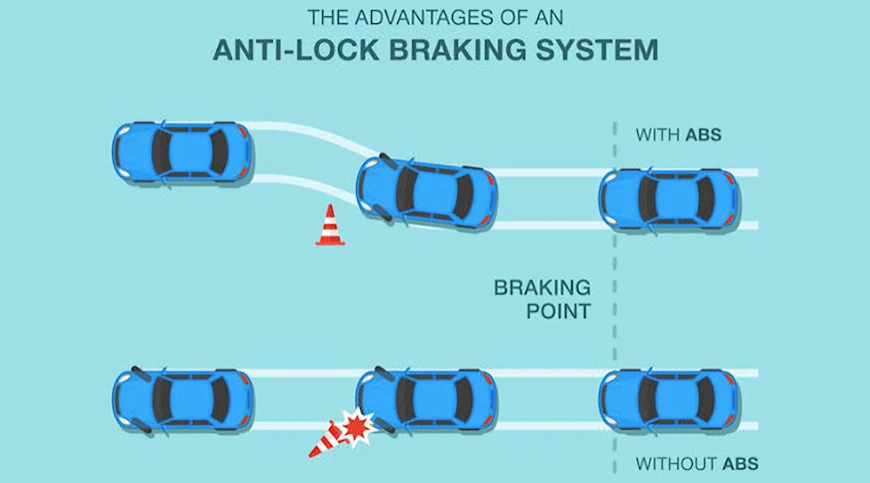
During hard braking, particularly on wet, icy or slippery roads, a wheel can stop rotating while the vehicle is still moving. Once a wheel locks and begins to skid, steering control is greatly reduced.
ABS continuously monitors the speed of each wheel. If the system detects that one is about to lock, it rapidly reduces and reapplies braking pressure to that wheel. This can happen many times per second – far faster than a driver could achieve by manually pumping the brake pedal.
The objective isn’t simply to reduce stopping distance. More importantly, ABS helps keep the wheels rotating so you can continue to steer while braking heavily.
If you’ve ever felt the brake pedal rapidly pulsing during an emergency stop, you’ve probably experienced ABS in action. The vibration and mechanical noises that sometimes accompany it are normal. Keep firm pressure on the brake pedal and concentrate on steering the vehicle safely.
How does ABS work?
A typical ABS system uses wheel-speed sensors to continuously measure how quickly each wheel is rotating. This information is sent to an electronic control unit (ECU), which compares the signals from the wheels.
If the ECU identifies a wheel approaching lock-up, a hydraulic modulator uses electrically controlled valves to adjust the braking pressure at that wheel. A hydraulic pump then helps restore pressure when required.
Modern vehicles also use this wheel-speed information for other safety systems, including traction control and Electronic Stability Control (ESC).
Why is my ABS warning light on?
It’s normal for the ABS warning light to appear briefly when you start the car while the system performs a self-check. It should then go out.
If the light remains illuminated or appears while you’re driving, the system has detected a fault.
Possible causes include:
A faulty wheel-speed sensor
Damaged wiring or electrical connections
A damaged or corroded ABS reluctor or encoder ring
A wheel-bearing problem
A fault with the ABS pump or hydraulic unit
An ABS control-unit or electrical fault
A diagnostic scan can identify stored fault codes, but a code doesn’t necessarily tell you which component needs replacing. For example, an incorrect wheel-speed signal could be caused by the sensor, wiring, encoder ring or wheel bearing.
Proper diagnosis may involve examining live wheel-speed data, testing electrical signals and physically inspecting the relevant components.
Can I drive with the ABS light on?
If only the ABS warning light is illuminated, your conventional brakes will usually continue to operate, but the anti-lock function – and potentially other safety systems that depend on it – may be unavailable.
You should therefore have the fault investigated rather than ignoring the warning.
If the ABS warning appears alongside a red brake warning light, or you notice reduced braking performance or a change in brake-pedal feel, the vehicle should not simply be driven as normal.
An ABS malfunction can also result in an MOT failure, so it’s sensible to have warning lights investigated before your MOT is due.
ABS problems? JLE Autos can help
ABS is only one part of your vehicle’s braking system. Sensors, electronics, brake pads, discs, calipers, wheel bearings, tyres and brake fluid all contribute to safe and predictable braking.
At JLE Autos, we diagnose ABS and braking-system faults across a wide range of makes and models. Rather than simply replacing the component mentioned in a fault code, we’ll investigate the underlying problem and advise you on the appropriate repair.
If your ABS warning light is on, your brakes don’t feel quite right, or you simply want some professional advice, contact JLE Autos in Gloucester and we’ll be happy to help keep you safely on the road.


